01
Authoritative facts
People, positions, qualifications, training, credentials, availability, equipment, locations, and source identifiers.
A governed operating environment for workforce readiness, incident staffing, deployment, responder accountability, equipment, learning, and reporting.
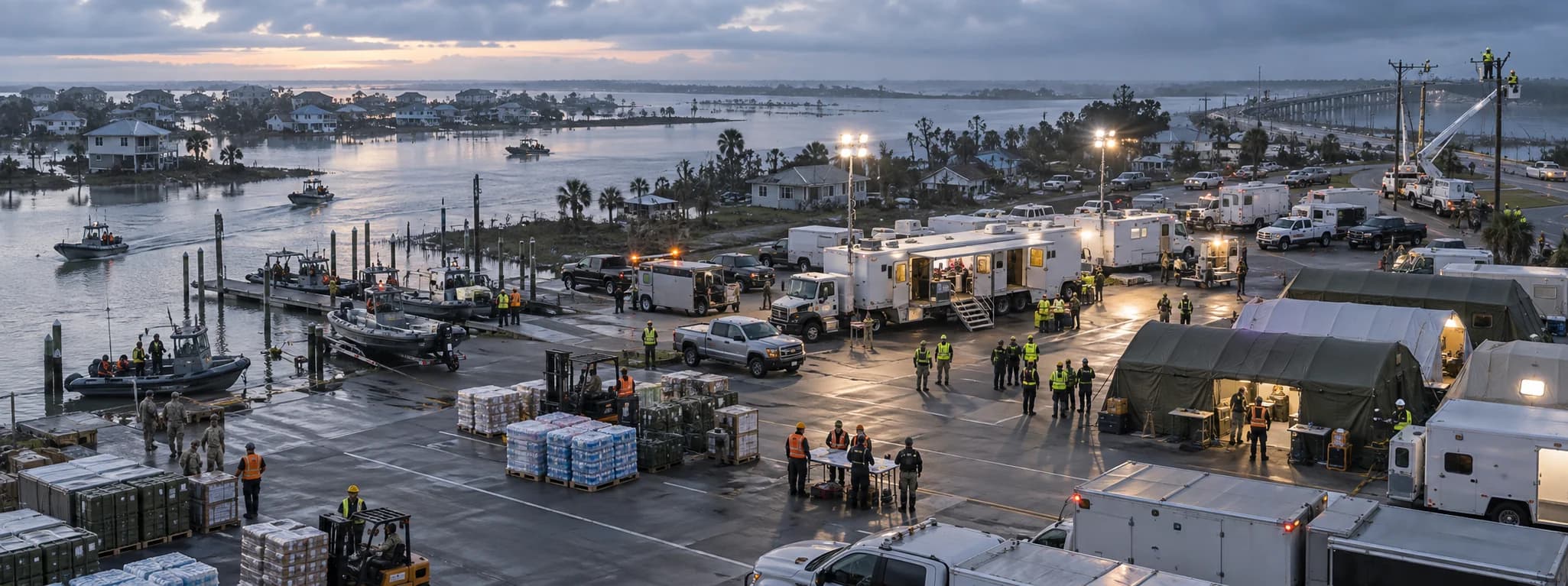
The operation should stay coordinated when the environment does not.
Explore the scene to see how people, resources, and decisions remain connected during a response.
Emergency response fails when personnel, qualification, availability, deployment, equipment, and reporting facts live in separate systems. Leaders are forced to make time-sensitive decisions from stale exports, disconnected messages, and manually reconciled spreadsheets.
USATII has built a working deployment-management system around the full decision chain: establish authoritative workforce facts, explain readiness, staff an incident, review orders, account for responders and equipment in the field, preserve every material decision, and close with reproducible records.
Explore the complete capability catalog01
People, positions, qualifications, training, credentials, availability, equipment, locations, and source identifiers.
02
Staffing requests, readiness checks, reviewed orders, assignments, custody, exceptions, and approvals.
03
Travel, station activity, daily accountability, status changes, evidence, equipment movement, and demobilization.
04
Immutable versions, policy references, decision history, audit events, private reports, and exportable records.
01
Define personnel, position, qualification, training, credential, and availability facts.
02
Create incident needs and teams, then compare candidates against current evidence and conflicts.
03
Route deployment orders through independent review, acceptance, and versioned extensions.
04
Track travel, duty stations, supervisors, daily replies, time away, equipment, and exceptions.
05
Reconcile end steps, equipment holds, checkout, evaluations, time records, and saved reports.
Every module shares scoped identity, effective dates, record versions, policy references, audit history, and reporting boundaries. The result is a system that can explain not only what happened, but what facts and authority supported the decision.
01
Canonical people, source identities, employment and position history, scoped access, corrections, and audit evidence.
02
Task books, qualifications, training records, credentials, availability, evidence review, certification, and interval-based readiness.
03
Exercises and incidents, duty stations, staffing needs, teams, saved rule versions, and controlled lifecycle changes.
04
Candidate checks, draft and reviewed orders, acceptance, extensions, replacements, travel, check-in, and demobilization.
05
Daily checks, supervisor coverage, time away, missed-response escalation, private details, and location history.
06
Issue, transfer, return, inspection, repair, loss review, retirement, custody history, and deployment-linked holds.
07
Mentoring, development plans, course catalogs, enrollment, attendance, assessments, remediation, credit, and transcripts.
08
Private, reproducible reports for staffing, deployment status, daily checks, team readiness, credentials, training, and equipment.
09
Bounded correction batches, preview and undo, source reconciliation, immutable history, and explicit provenance.
10
Effective-dated roles, organization and incident scope, stale-write protection, idempotent commands, private files, and policy records.
Organization-, person-, incident-, and role-scoped access
Immutable decision history and explicit record provenance
Safe retries, stale-write checks, and bounded commands
Responsive, keyboard-accessible operational workspaces
Private reports with rule and source snapshots
Clear separation between evidence, review, and authority
Bring the mission workflow, governing rules, source systems, security boundary, and acceptance criteria. We will define a focused implementation path.
The system described here is a working software build with synthetic test data. Production use requires customer-approved rules, integrations, infrastructure, security authorization, accessibility review, and operational acceptance. USATII is not claiming FEMA endorsement or production authorization.